- November 17, 2026
- DrnikhilK
- 9:24 am
Artificial Disc Replacement – An Alternative to Spinal Fusion!
What Is Artificial Disc Replacement?
Artificial disc replacement is a surgical procedure that removes a damaged or degenerated spinal disc and replaces it with an artificial disc implant. The implant acts as a cushion between two vertebrae and allows controlled movement.
The spine contains small discs between the vertebrae that absorb shock and support flexibility. However, age-related changes, injuries or disc degeneration can affect their function. As a result, patients may experience persistent pain, stiffness, numbness or other nerve-related symptoms.
Therefore, an artificial disc replacement procedure may become a treatment option when non-surgical methods fail to provide sufficient relief.
What Is Spinal Fusion?
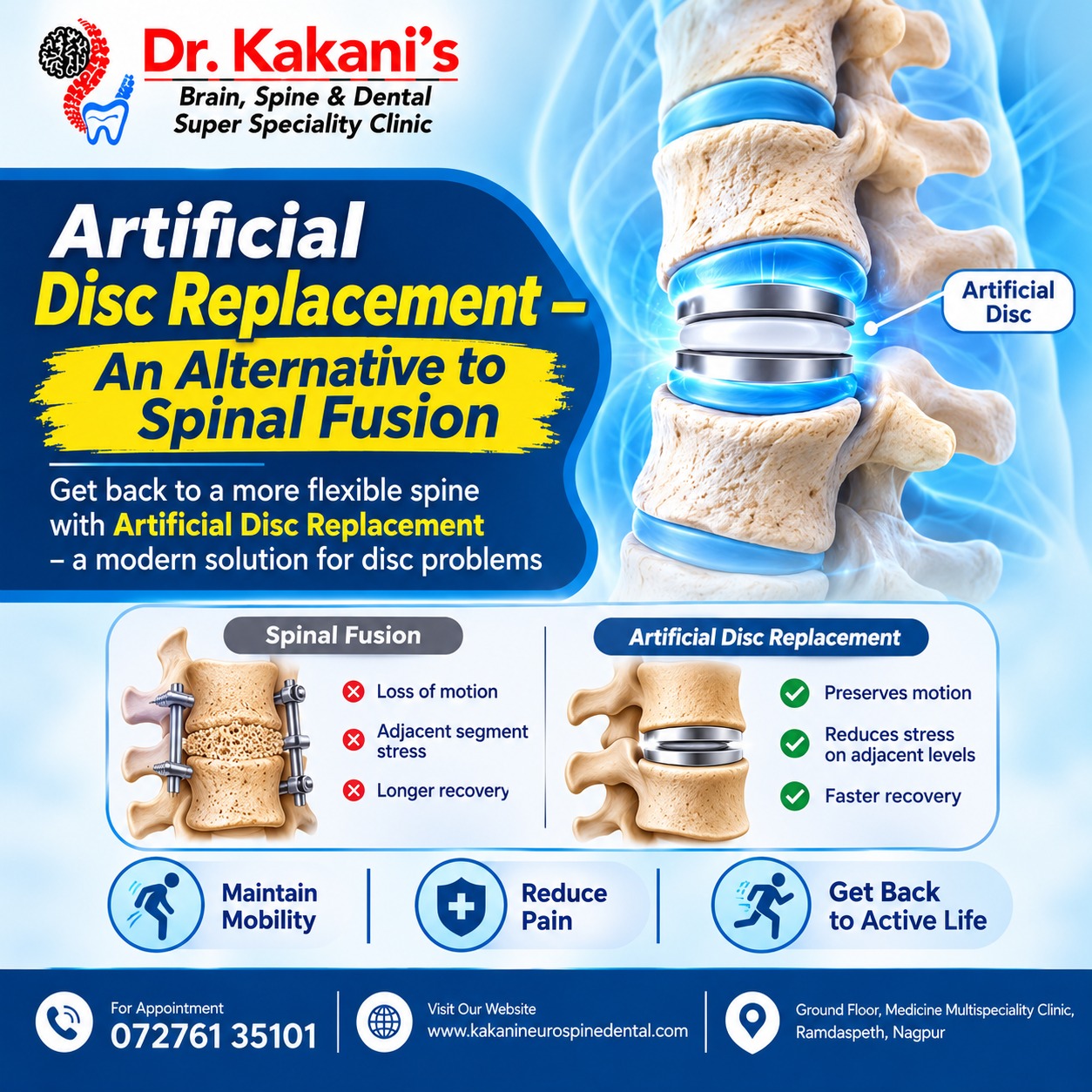
Artificial Disc Replacement vs Spinal Fusion
Both procedures aim to treat certain spinal conditions, but they work differently.
| Feature | Artificial Disc Replacement | Spinal Fusion |
|---|---|---|
| Main purpose | Replaces the damaged disc | Joins vertebrae together |
| Spinal movement | Preserves movement at the treated level | Stops movement at the fused level |
| Implant | Artificial disc | Bone graft and fixation implants |
| Recovery | Depends on the patient and procedure | Depends on fusion healing |
| Suitability | Selected patients with suitable anatomy | Various spinal conditions |
Moreover, neither procedure is suitable for every patient. A spine specialist evaluates the benefits and limitations before recommending surgery.
Who May Need Artificial Disc Replacement?
Artificial disc replacement may benefit selected patients with symptomatic disc degeneration, particularly when the damaged disc causes persistent pain or nerve compression.
A spine specialist may consider this procedure when:
You experience persistent neck or lower back pain.
You have cervical or lumbar disc degeneration.
Your symptoms do not improve with medication or physiotherapy.
You experience pain, tingling or numbness due to nerve compression.
Imaging tests identify a damaged disc that matches your symptoms.
You meet the medical and anatomical requirements for disc replacement.
However, patients with severe spinal arthritis, significant spinal instability, osteoporosis or certain other spinal conditions may not qualify for this procedure.
Types of Artificial Disc Replacement
Artificial disc replacement mainly involves two areas of the spine:
1. Cervical Artificial Disc Replacement
Cervical artificial disc replacement treats certain damaged discs in the neck. During surgery, the surgeon removes the affected disc and places an artificial implant between the cervical vertebrae.
Moreover, this procedure aims to relieve nerve pressure while preserving movement in the treated neck segment. Doctors may recommend it for selected patients with cervical disc degeneration or nerve compression.
2. Lumbar Artificial Disc Replacement
Lumbar artificial disc replacement treats selected damaged discs in the lower back. The surgeon removes the affected disc and places an artificial implant between the lumbar vertebrae.
However, lumbar disc replacement requires careful patient selection because factors such as spinal alignment, facet joint health and bone quality can affect the outcome.
What Are the Benefits of Artificial Disc Replacement?
Artificial disc replacement offers several potential benefits for suitable patients.
Preserves spinal movement: The artificial implant allows controlled movement at the treated level.
May relieve pain: Removing the damaged disc can reduce symptoms caused by disc degeneration or nerve compression.
Maintains flexibility: The procedure aims to preserve movement in the treated spinal segment.
May reduce stress on nearby levels: Some studies suggest that motion-preserving surgery may reduce additional stress on adjacent spinal segments.
Supports daily activities: Successful treatment may help patients return to their regular activities.
Nevertheless, results vary between patients, and artificial disc replacement does not guarantee complete pain relief or prevent future spinal problems.
How Is Artificial Disc Replacement Performed?
Artificial disc replacement involves several carefully planned surgical steps.
Step 1: Pre-Surgical Evaluation
First, the spine specialist reviews the patient’s medical history, symptoms and imaging reports. X-rays, MRI scans or CT scans may help assess disc damage and spinal structure.
Step 2: Anaesthesia
The surgical team administers general anaesthesia to keep the patient comfortable throughout the procedure.
Step 3: Removal of the Damaged Disc
Next, the surgeon accesses the affected spinal segment and carefully removes the damaged disc. The surgeon also addresses any relevant nerve compression.
Step 4: Artificial Disc Placement
The surgeon positions the artificial disc implant between the vertebrae. The implant provides support while allowing controlled movement.
Step 5: Closure and Recovery
Finally, the surgeon closes the surgical incision and transfers the patient to the recovery area for monitoring.
Recovery After Artificial Disc Replacement
Recovery depends on the type of surgery, the patient’s overall health and individual healing progress.
Moreover, patients should follow their surgeon’s instructions carefully during recovery.
Common recovery recommendations include:
Begin walking when the medical team allows it.
Avoid heavy lifting during the initial recovery period.
Follow prescribed medications and wound-care instructions.
Attend scheduled follow-up appointments.
Start physiotherapy when recommended.
Gradually return to regular activities according to medical advice.
However, patients should contact their doctor if they develop fever, worsening pain, wound discharge, new weakness or other concerning symptoms.
What Are the Possible Risks of Artificial Disc Replacement?
Like every major surgical procedure, artificial disc replacement carries certain risks. These may include:
Infection
Bleeding
Nerve injury
Persistent pain
Implant displacement or wear
Difficulty swallowing after certain cervical procedures
Blood vessel injury
Need for additional surgery
Therefore, patients should discuss the potential risks, expected benefits and alternative treatments with their spine specialist before making a decision.
Is Artificial Disc Replacement Better Than Spinal Fusion?
Artificial disc replacement is not necessarily better than spinal fusion for everyone. Both procedures treat specific spinal conditions and offer different advantages.
Artificial disc replacement may suit patients who want to preserve spinal movement and meet the required medical criteria. In contrast, spinal fusion may provide better stability for patients with certain spinal deformities, instability or advanced degenerative changes.
Therefore, a detailed clinical evaluation helps determine the most appropriate surgical approach.
When Should You Consult a Spine Specialist?
Consider consulting a spine specialist if you experience:
Persistent neck or back pain
Pain spreading into your arms or legs
Tingling or numbness in your hands or feet
Difficulty performing everyday activities
Repeated symptoms despite conservative treatment
Muscle weakness or changes in coordination
Seek urgent medical attention if you develop new bladder or bowel control problems, numbness around the groin or rapidly progressing leg weakness.
Conclusion
Consult Dr. Kakani's Clinic
Dr. Kakani’s Brain, Spine & Dental Super Speciality Clinic
Appointment: 07261 35101
Website: www.kakineurospinedental.com
Address: Ground Floor, Medicine Multispeciality Clinic, Ramdaspeth, Nagpur.